
| Multimedia
techniques taught at new centre By Dave Clements |
| A
tiny office in the basement of the MacLaurin Building is the home
to some of UVic’s most advanced computer technology. The Multimedia Arts Centre’s Dr. Don Bergland and Dr. Dale McIntosh are putting this technology to work, teaching students how to manipulate audio and video material into multimedia productions. “We’re small, but we’re getting the maximum we can get out of our programs,” Bergland says. “We would like to see ourselves as a development program for students.” The centre, operated through the Department of Arts in Education, currently offers three courses in multimedia production techniques: AE 322, AE 402, and ME 402. Teaching multimedia means showing students how to integrate audio and visual matter, scripting and storyboarding them into computer productions. Most students are in the Education faculty, but recently there has been a demand for courses by students in writing, visual arts, computer science, and physics. While the main purpose of the centre is still to train teachers who can share the information with their students, the possibilities for multimedia are expanding. An example is the increasing use of 3D Modeling, the creation and manipulation of three-dimensional computer images. The technique is being used in areas as diverse as animation, architecture, and advertising. “The 3D Modeling industry is generating $40 billion a year,” Bergland says, noting that the video game industry is now a larger field than television or movies. Multimedia skills have recently been |
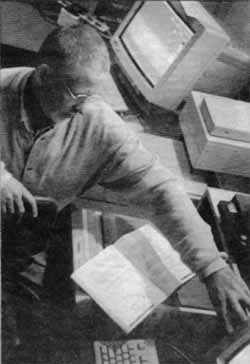 |
| Don
Bergland Dave Clements Photo applied for purposes other than entertainment. For example, the use of 3D modeling has become important in the medical field - medical students can now simulate an open heart surgery before actually performing one. However, some of the most prominent uses of the technology remain in the entertainment field. McIntosh estimates that at least 30 percent of movies made today have an electronic score, as computer technology allows the composer to create many different tracks, layering one instrument on another for a full sound. Filmmakers can also integrate their video and soundtracks. Much of the centre’s equipment is available elsewhere on campus, but the centre is the only place the equipment is being used to teach, Bergland says. Students can gain experience in areas as diverse as QuickTime movie making, 3D animation, and video editing. |
| McIntosh
has been teaching music for 10 years in the department, starting with
an old IBM clone and a keyboard. later, Bergland began teaching visual
arts with the department’s computers. Two years ago, Bergland
and McIntosh joined forces to create the multimedia centre. They will
likely graduate 60 students from the three courses offered. While Bergland’s background is in visual arts and McIntosh’s in music and electrical engineering, the partnership has been harmonious, both say. “Don finds the stuff I’m doing more interesting than what he’s doing, and I find his stuff more interesting,” McIntosh says. Both professors have had extensive involvement with the technology-based industries, and see endless possibilities for graduates with skills in multimedia. Bergland recently spent some time as director of visual arts for Electronic Arts, one of the largest interactive entertainment companies in the world. “Both of us are in contact with industry, and we’re teaching skills that are relevant to them,” Bergland says. “Anything you can imagine doing visually, you can do with this equipment.” Even technophobes take to the software, he adds. “At first they’re intimidated.” he says, “but I’ve had students who have never touched a keyboard who get into it when they see what it can do for them.” Multimedia will not only provide opportunities for graduates, but it will be essential to them, he says. Just as today’s teachers must be able to teach in the format, the architect of the future will need t o be able to create 3D models of future projects. And this is just the beginning. “It’s a new language of communication and expression,” he says, “ and we’re teaching the new literacy. |
| THE RING | December
8, 1995 - 7 |