Artist
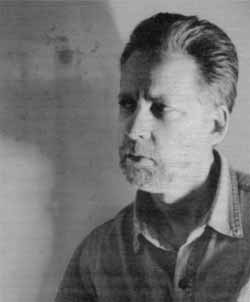
and professor Dr. Don Bergland (Arts in Education) has returned
to the academic milieu following a one-year immersion in the world
of video gaming; a world he describes as dollar driven. His hiatus
from UVic was spent as Director of Visual Arts for Electronic Arts
(Canada), one of the world’s largest video gaming producers.
In response to his immersion in electronic arts, Bergland has returned
to traditional studio and is working a series of lyrical landscapes
executed in acrylics on canvas.
“Some
of my colleagues would die for the chance to get in there. But [having
spent a year in the industry] I know that [the industry] doesn’t
allow for good solid creative endeavor,” says Bergland.
Bergland is a man with a varied career - professor, painter, sculptor,
multimedia artist, writer, radio and video producer, and educator.
Born in Vancouver, he has lived, worked and taught throughout BC.
Places such as Bowser, Bella Coola Valley and Ucluelet, which appear
in his biography, suggest the sense of adventure and exploration
which took him away from UVic.
“It seemed like a great opportunity to enhance my creativity.
I thought being involved with Electronic Arts would provide me with
better opportunities to explore innovative endeavors than the academic
world did. I learned that [in the industry] creative thought and
experimentation are avoided completely.”
Bergland was surprised by this because, as he describes it, the
video gaming industry is young and growing fast - it seems to rest
on the innovative ideas generated by those working in the industry.
It’s a stunning world out there in terms of technology. The
video entertainment industry is constantly pushing the use of technology,
constantly trying to rebuild or reinvent another reality,”
says Bergland.
Electronic Arts is a leader in video gaming production. The company
has five branches throughout the world and produces video games
for Sega Genesis, Nintendo and PC CD. Bergland says he was attracted
to the job for a number of reasons. The average age of Electronic
Arts (Canada) employees is 24-25 years - Bergland describes them
as “young minded, bright, and very, very creative.”
The target market is youth culture; the industry is growing rapidly
and commands an enormous amount of money; and the tools used are
on the cutting edge of technology.
When hired on as Director, Bergland says, he had to create and administer
an organizing structure for the company’s |
|
huge
studio of 40 artists.
‘There
was no clear vision for the art department and the artists were
working without direction.”
Bergland provided that direction, designing a structure for the
studio which included a strong vision and focus, training programs,
procedures for hiring and firing, and provisions for developing
the artists’ talents.
His department worked primarily on sports games (soccer, baseball,
and race car driving simulators) although, when originally hired,
he was given the impression the company was branching into “edutainment”
- video games providing education with entertainment.
Despite the challenge, the bright and youthful staff, the money,
and computer gadgets at his disposal, Bergland says one year of
immersion in the electronic world was enough.
“The dollar is the bottom line. Creative freedom and experimentation
are avoided and there is a constant thrust toward distilling more
money out of the product. If an idea doesn’t generate more
money it’s dropped immediately,” says Bergland.
Bergland says his year with Electronic Arts (Canada) was valuable
because it has provided him with a better sense of the world his
students have to prepare for.
Electronic media plays a central role in youth culture, Bergland
says. He believes that his year at Electronic Arts (Canada) gave
him a good understanding of how the industry attracts and captures
its target audience - youth - and that he can apply that knowledge
when teaching his students the importance of understanding youth.
‘The Faculty of Education does not recognize the absoluter
growth and dominance of the electronic and digital world. We continue
to teach using formats and structures that are outmoded. And we’re
not preparing teachers to understand youth culture - without that
knowledge they wind up alienating their students.”
“In particular, Bergland says his year with Electronic Arts
(Canada) showed him the importance of teaching and teamwork.
“Kids are not taught how to work in teams. We should be teaching
them to work within a team structure - it’s a very valuable
skill. If you work in film, video, with magazine publishing or the
media. you have to know how to communicate - how to work with others
on a team.”
As an example, says Bergland (who was |
|
 |
instrumental
in setting up the Faculty of Education’s electronic teaching
studio) the artists he worked with during the past year started off
unable to articulate their ideas toproducers or directors and, in
general, couldn’t communicate well with other artists or team
members. One of the first things he did was set up a training program
to teach them these skills.
After his return, he plunged into the electronic art experience one
more time, presenting a large multimedia production, Borax Jamboree,
described as an “outré festival of experiential explorations
into cultural eccentricities, designed to satirize modern death-induced
flights into conditioned obsession.” The production involved
the use of dual projectors, and electronic dissolve unit, and sound
equipment. “I wanted to see how I’d respond to something
totally creative and electronic. It was an interesting event, but
I came out of it realizing that dealing with such a cult/fringe audience
is not fulfilling for me. I came away feeling somewhat disillusioned
and decided to place myself in the exact opposite studio experience.
I’ve hardly touched my electronic studio since.”
A return to the traditional studio has Bergland painting in acrylics
on canvas. His latest works are a series of lyrical harmonious landscapes
which act as “a metaphor for intellectual and spiritual endeavor.”
My main goal is to enhance my creativity and pursue creative endeavors.
UVic allows for creative growth that’s meaningful to me. Through
working on the interpretive landscape paintings and returning to the
traditional studio, I’ve returned to an exploration of larger
philosophical questions.”
Bergland will hold a solo exhibition of his coastal landscapes at
Hidden Space Gallery, Jan. 19 to Feb. 2. |
|
